Commercial Construction Guide · Closeout & Change Management
How We Handle Last-Minute Changes Before Commercial Handover of Drywall Installation Project in Vancouver
The final weeks before handover are when plans change. A tenant wants a wall moved, an inspector flags a gap, or another trade damages a finished surface. As a commercial drywall contractor serving Vancouver and the Lower Mainland, we handle these changes from drywall installation through to finish with a clear process, so the handover date holds and quality does not slip.
Quick Answer: Managing Late Handover Revisions
A commercial drywall contractor handles last-minute changes by logging the request in writing, checking the impact on scope, fire ratings, inspections and schedule, agreeing price and timing, protecting finished areas, completing the work to the same finish standard and updating the punch list and closeout records.
Why Late Changes Are So Risky Near Handover
By this stage, drywall is finished, painted or about to be. A late change can mean opening a wall, disturbing a rated assembly, re-inspecting work and repainting. It also puts pressure on every trade that follows. Without a controlled process, small requests turn into delays and disputes.
In Metro Vancouver commercial developments, occupancy dates are tied directly to tenant lease commencement, commercial financing milestones, and municipal building inspections. When drywall modifications occur late in the schedule, dust migration can contaminate HVAC return ducts, damage newly laid carpet or vinyl flooring, and trigger re-inspections that threaten scheduled turnover.
Common Last-Minute Drywall Changes
- Moving or adding partition walls: Accommodating unexpected tenant space reconfigurations or added private offices.
- New outlets, fixtures or blocking for mounted items: Adding internal wood or steel backing for heavy commercial displays, AV equipment, or millwork.
- Ceiling, bulkhead or access panel changes: Creating drywall access hatches for newly installed plumbing valves or mechanical dampers.
- Different finish level or paint colour requests: Upgrading specific feature walls from Level 4 to Level 5 under critical lighting.
- Rework after a failed inspection: Correcting firestopping penetrations or sound partition seals flagged by municipal inspectors.
- Repairs after damage from other trades: Fixing scuffs, corner gouges, or holes caused by flooring, electrical, or data cabling contractors.
Our Six-Step Process for Handling Late Changes
To protect project schedules, maintain cost transparency, and uphold finish standards, our commercial drywall installation crews follow a structured six-step workflow:
Log the Request in Writing
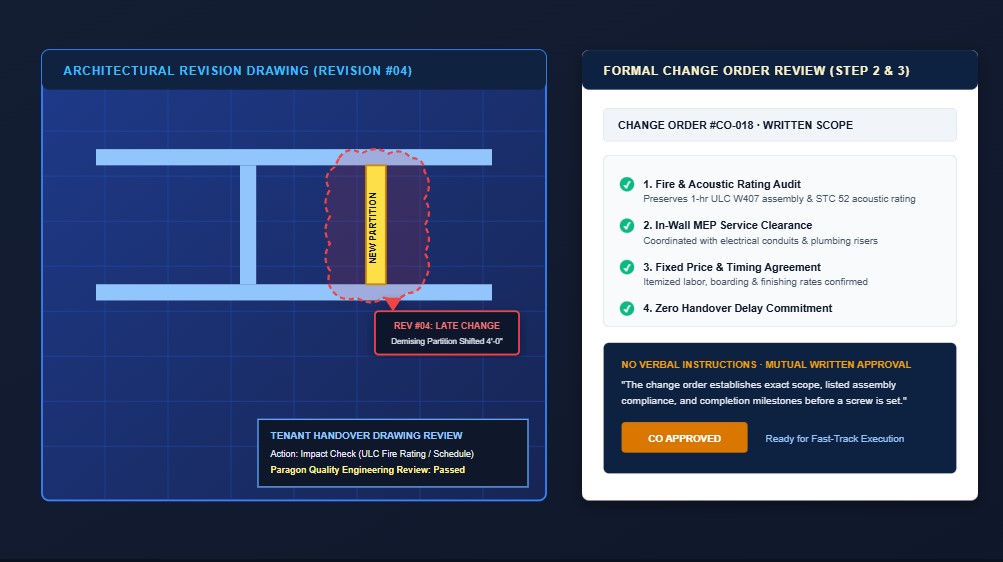
Every change starts as a written request through the general contractor, with location, drawings or photos and the reason. This avoids verbal instructions that cause disputes later.
Check the Impact
We review whether the change affects rated walls, sound control, services behind the wall, inspections or finishes, and what it means for the schedule. Fire-rated or sound-rated walls must keep their assembly. Confirm requirements with your consultant and the BC Building Code.
Agree Price and Timing in Writing
We give a clear price, duration and any dependencies before starting. The general contractor approves it through a change order, so nobody is surprised at closeout.
Plan the Work and Protect Finished Areas
We sequence the work to avoid damaging completed areas, using floor protection, dust barriers and dust-controlled sanding. Where possible, we schedule the work outside tenant hours.
Complete to the Same Finish Standard
New work is built, taped and finished to match the approved mock-up and the specified level of finish, following Gypsum Association guidance. We coordinate with painters so patches blend in. Our approach to one site, one team, one standard of quality applies right up to handover.
Re-Inspect and Update the Records
We re-inspect the area with raking light, record it with photos and update the punch list and closeout documents, so the change is closed out properly.
How We Handle Each Type of Change
Different late modifications introduce distinct construction risks. Here is how our team mitigates each specific challenge:
| Change | Main Risk | How We Handle It |
|---|---|---|
| Moved or added wall | Rated assembly, services behind wall | Check drawings and trades first, build to listed ULC assembly with required firestopping |
| New outlets or blocking | Cutting into finished work | Mark locations accurately, cut cleanly with dust extraction, install solid steel/wood backing, patch and refinish |
| Ceiling or bulkhead change | Schedule and access | Sequence with mechanical/electrical trades, protect finished floor finishes with heavy Ram Board |
| Finish or paint change | Rework and drying time | Agree on required finish level (Level 4/5) and timing, build a sample panel first to verify sheen |
| Failed inspection | Delay to occupancy | Rectify deficiencies immediately using rapid-setting chemical compound, re-inspect, record photographic result |
Managing the Punch List Near Handover
A punch list should never be a source of chaos at the end of a project. We manage closeout deficiencies with a systematic five-step approach:
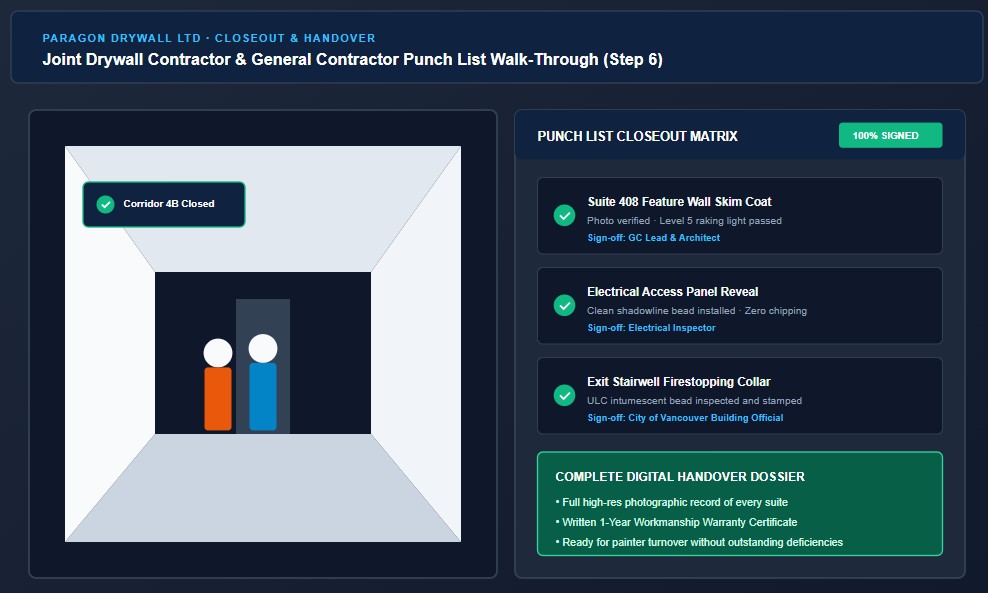
- Walk the site with the general contractor and record every item with photos: Joint inspection ensures agreement on what constitutes an actual deficiency versus normal paint prep.
- Group items by area so crews work efficiently: Technicians sweep through designated zones, completing framing fixes, compounding, and sanding in coordinated passes.
- Fix and re-inspect each item, then close it with a photo: Deficiencies are corrected using fast-curing compounds and dust-free extractors, verified under raking light, and photographed.
- Keep one shared list so nothing is lost between trades: We utilize a synchronized digital punch list accessible to the GC superintendent and trades, avoiding conflicting notes.
- Hand over only when the list is clear: Handover is officially requested only when zero open drywall deficiencies remain on the log.
For how we organize and plan projects earlier in the construction cycle, explore our comprehensive guide to commercial drywall project planning and installation.
How Owners and General Contractors Can Reduce Late Changes
While late modifications can always be accommodated, proactive pre-construction planning significantly reduces stress and expense:
Best Practices to Prevent Handover Bottlenecks
- Confirm tenant layouts and finish levels before boarding: Lock in demising partition layouts and Level 4 vs. Level 5 specifications before gypsum panels are fastened.
- Decide on blocking for fixtures, TVs and signage early: Coordinate AV display locations, heavy grab bars, and millwork backing while steel studs remain open.
- Hold a pre-handover walk-through with all trades: Review ceiling penetrations, access panels, and mechanical rough-ins prior to the final taping pass.
- Protect finished drywall from other trades: Implement strict site protection protocols so flooring installers, electricians, and painters do not damage completed corners.
- Use one written change process for every request: Ensure all site changes route through formal change orders with agreed pricing and schedule milestones.
What to Ask Your Commercial Drywall Contractor
Before awarding commercial fit-outs or multi-residential projects, ask your drywall subcontractor these five critical closeout questions:
- How do you document and price late changes? Verify they operate on transparent written change orders with fixed itemized rates.
- How do you protect finished areas during changes? Ensure they utilize heavy floor runners, sealed negative-air poly enclosures, and vacuum-shrouded sanders.
- How do you keep the finish consistent on new work? Confirm they match approved benchmark mock-ups and inspect under raking light.
- How do you manage the punch list? Inquire whether they deploy dedicated deficiency-clearing crews with digital tracking.
- Are your WorkSafeBC clearance and insurance current? Confirm active safety standing and adequate commercial liability coverage.
Verified Credentials: Why Metro Vancouver Chooses Paragon Drywall Ltd.
Paragon Drywall Ltd. is a woman-owned commercial drywall subcontractor serving Vancouver, the Lower Mainland and the Fraser Valley for over 15+ years of continuous operations. We deliver commercial tenant improvements, institutional builds, and multi-residential drywall projects from initial framing to final handover.
- Landmark Portfolio: Proven execution on high-profile developments, including Station Square Tower in Burnaby and Alexander College in Vancouver.
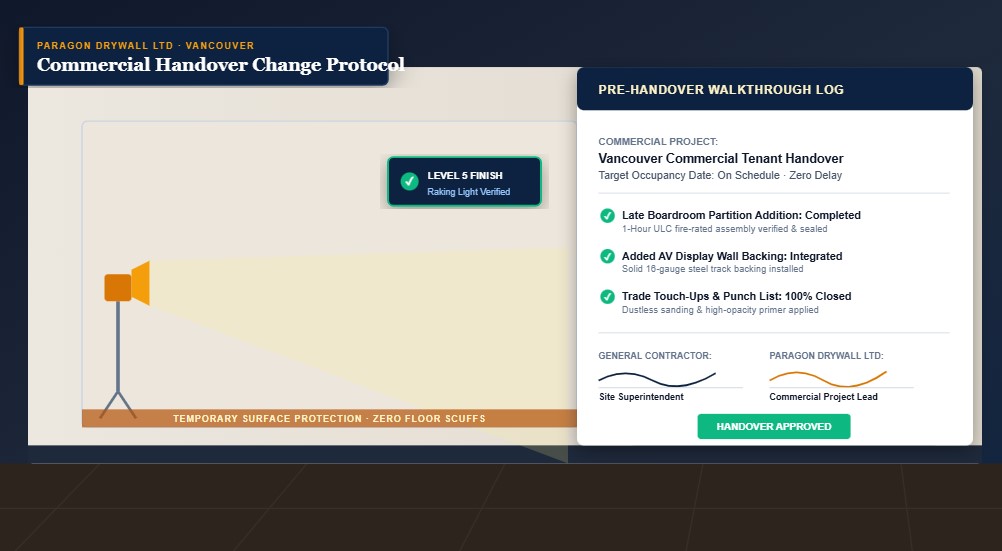
- Real Handover Case Proof: On a recent Downtown Vancouver office fit-out, an anchor tenant submitted an urgent late change three weeks before occupancy to add an executive boardroom partition and AV backing. Our team reviewed the 1-hour ULC fire-rated assembly, established after-hours dust containment, deployed chemical-setting compounds, and completed a Level 5 finish without shifting the handover date by a single day.
- Compliance & Safety: Active WorkSafeBC clearance in good standing, $5,000,000 commercial general liability insurance, and rigorous BC Building Code alignment.
Explore our completed portfolio of finished drywall projects and review our specialized services.
Finish Strong With a Commercial Drywall Contractor Who Stays Organized
Need a commercial drywall contractor who keeps your handover on track when plans change? Share your architectural drawings, target handover date, and any open scope changes with our estimating team today.
Frequently Asked Questions
How does a commercial drywall contractor handle last-minute changes before handover?
They log each request in writing, check the impact on rated walls, services, inspections and schedule, agree price and timing through a change order, protect finished areas, complete the work to the same finish standard and update the punch list and closeout records.
Why are late drywall changes risky near commercial handover?
Drywall is usually finished or painted by then. A late change can mean opening a wall, disturbing a rated assembly, re-inspecting and repainting, which puts pressure on every following trade and can delay occupancy.
Can walls be moved or added shortly before handover?
Often yes, but the change must be checked against drawings, rated assemblies, services and inspections first. The general contractor and consultant should approve the change in writing before work starts.
What is a drywall punch list?
A punch list is a record of remaining defects or incomplete items found during the final walk-through. Each item is fixed, re-inspected and closed with a photo, and handover should happen only when the list is clear.
How do you keep the finish consistent on late repairs or additions?
By building to the approved mock-up and specified finish level, coordinating with painters so patches blend in, and re-inspecting the area with raking light before closing the item.
Does Paragon Drywall serve areas outside Vancouver?
Yes. Paragon Drywall Ltd. Company serves commercial and multi-residential projects across the Lower Mainland and the Fraser Valley.