Multi-Unit Construction Guide · Quality Assurance Systems
One Building in Vancouver, Fifty Units: How We Keep Drywall Installation Quality Consistent
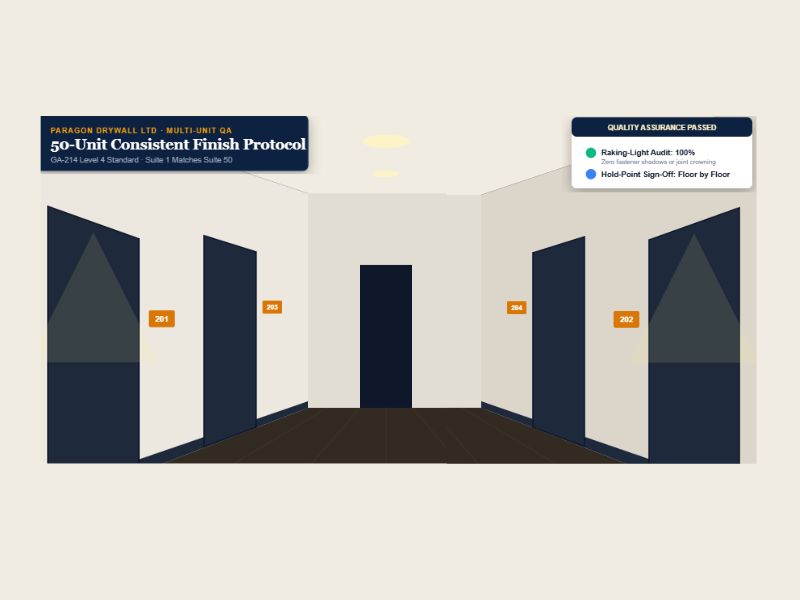
Fifty suites means fifty chances for a wall to look different from the one next door. Drywall installation quality control is what stops that from happening. In a single Vancouver building, every decision from board layout to the final sanding pass repeats fifty times, and any drift shows up once paint and lighting go on. At Paragon Drywall, a woman-owned commercial drywall contractor serving Vancouver and the Lower Mainland, we use a repeatable system so suite fifty matches suite one.
Quick Answer: How We Deliver Uniform Drywall in Every Suite
We keep drywall installation quality control consistent across 50 units by setting one written standard, approving a benchmark suite, assigning clear crew roles, inspecting every suite against a checklist, auditing a sample independently and logging every defect until it is closed.
Why Drywall Quality Drifts Across 50 Units
Quality rarely fails in one dramatic way. It drifts. A tired crew rushes a final coat, a new finisher joins mid-project, a delivery brings a different compound batch or a wet week changes drying times. Each change is small, but together they create visible differences between suites. A good system catches drift early, while fixing it is still cheap.
When fifty individual suites are boarded and finished without strict stage-gate hold points, small variances compound. A stud 1/8-inch out of plumb during Framing leads to crowned board joints during boarding, which forces excessive taping compound buildup, ultimately casting shadows under morning window light. Robust drywall installation quality control prevents that chain reaction from starting.
Our 6-Step System for Drywall Installation Quality Control
To ensure every suite in a multi-unit project meets identical craftsmanship standards, we operate a structured 6-step quality control system:
Write One Standard
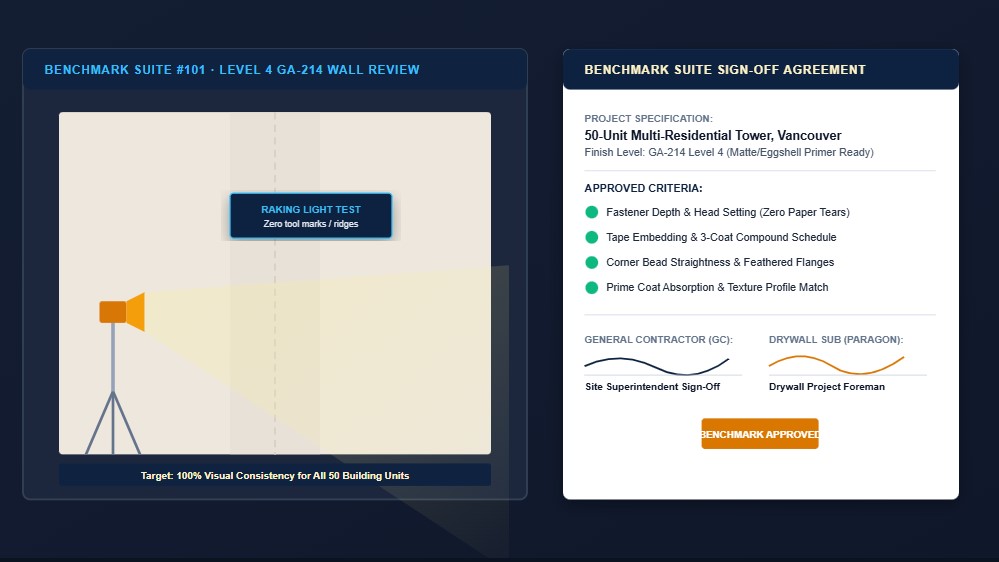
A single page sets the level of finish (Level 4 as described in GA-214), paint sheen, lighting and what counts as a defect. There is zero ambiguity about acceptable fastener depths, joint feathering widths, or corner bead tolerances.
Approve a Benchmark Suite
The general contractor and painter sign off one suite under final lighting. Every crew works to it. This approved physical benchmark serves as the visual and tactile contract for all remaining forty-nine suites.
Divide the Building into Zones
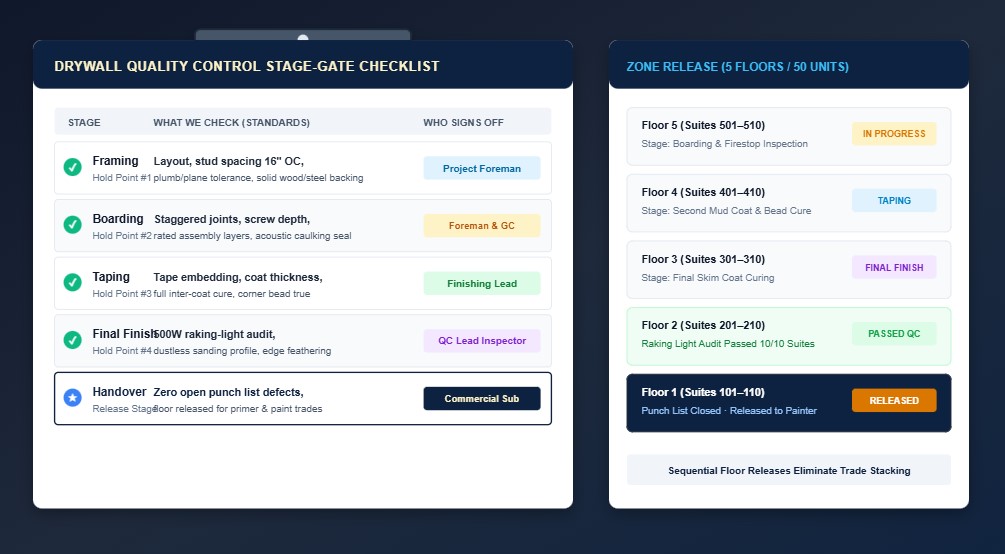
We inspect and release work floor by floor, never the whole building at once. In a five-storey, 50-unit development, each ten-suite floor represents an isolated milestone that must be fully signed off before the finishing crew advances.
Inspect Every Suite at Every Stage
Framing, boarding, taping and final finish each have their own checks. No board is hung until framing is verified, and no tape is embedded until board fastener depths pass inspection.
Audit a Sample Independently
A quality control lead who did not do the work re-checks a random selection of suites. This separation of production from verification guarantees that self-inspections remain honest and rigorous.
Log and Close Every Defect
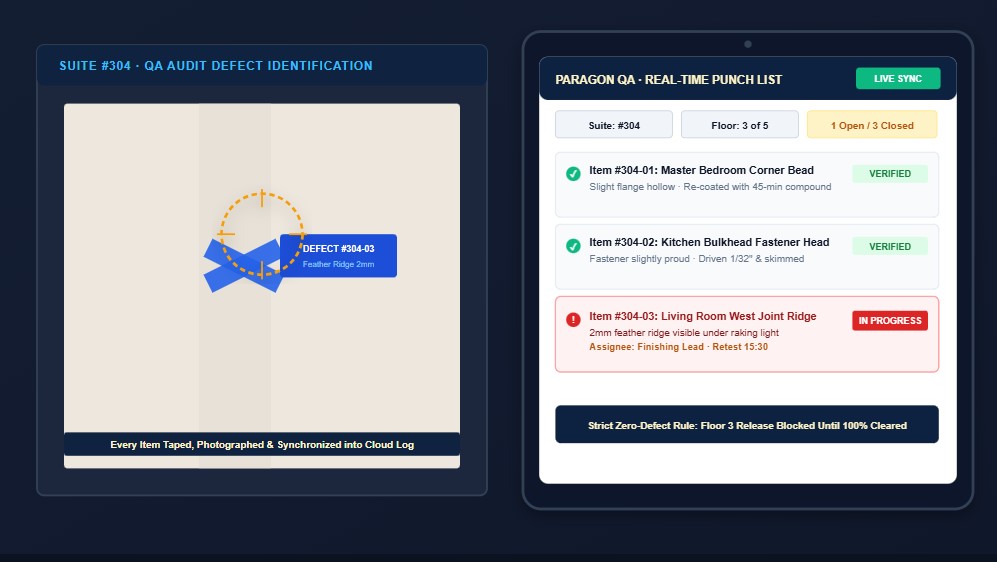
Nothing moves to the next stage while an item is open. Every minor imperfection is tagged, logged in a digital punch list, assigned to a finisher, and signed off once re-inspected.
Stage-by-Stage Checks
Quality control cannot be postponed to the final turnover walkthrough. Our crews enforce rigorous hold points at each distinct phase of construction:
| Stage | What We Check | Who Signs Off |
|---|---|---|
| Framing | Layout, plumb, stud spacing (16" OC), solid wood/steel backing for fixtures | Project foreman |
| Boarding | Joint placement, fastener depth without tearing face paper, rated assembly layers, acoustic sealant | Foreman and general contractor |
| Taping | Tape embedding without air bubbles, coat thickness, full drying between passes | Finishing lead |
| Final finish | 500W raking-light inspection, dustless sanding profile, zero ridges, dust removal | Quality control lead |
| Handover | Punch list closed, floor released for primer and paint trades | Commercial drywall contractor |
Why We Inspect at Every Stage
Fixing a crooked stud costs minutes during framing and hours after taping. Stage inspections stop errors from being buried under the next layer. When an out-of-plumb corner stud is discovered after three coats of compound have cured, correcting it requires cutting out gypsum, re-framing, re-boarding, and re-applying three coats of mud over several days. Inspecting at every stage ensures problems are eliminated when correction takes minutes.
Crew Roles That Keep Fifty Suites Uniform
Clear roles matter more than headcount on a multi-unit job. When tasks and inspection authorities are strictly defined, quality control becomes part of daily production:
Owns the overall production schedule, manages trade coordination with the GC, and enforces the written quality standard across all building zones.
Sets tool technique, compound mixing ratios, and trains all new finishers directly against the benchmark suite standard before they work in suites.
Operates independently from the production crew, conducts random sampling audits, and holds the sole authority to stop a floor from advancing.
Keeps one consistent compound system on site, tracks batch numbers, and coordinates just-in-time board hoisting to prevent site humidity exposure.
We also keep the same finishers on the same unit types throughout the building. A finisher who masters the intricate bulkheads and closet returns in Unit Type 'A' stays on Unit Type 'A' across all five floors. Anyone who joins mid-project trains on the benchmark suite first, and our quality control lead inspects their first suites with extra scrutiny before granting full production clearance.
Using Sampling and Punch Lists to Prove the System Works
Inspecting every suite catches visible defects. Independent sampling tests whether the system itself is working. Our quality control lead re-inspects a random selection of suites the crew has already passed. If the sample shows repeated defects—such as slight fastener crowning in north-facing master bedrooms—we stop, find the root cause, and re-check the entire zone.
Every defect goes into a shared digital punch list with the suite number, a photograph, an assigned finisher, and a status tag. Nothing is closed from memory. Only after our quality control lead verifies the correction under raking light is the item marked resolved.
Managing Vancouver Conditions Across the Whole Building
Humid, wet weather affects every suite in the same way, so we manage it building-wide. During fall and winter in Vancouver, ambient relative humidity routinely exceeds 80%. If joints are recoated before water evaporates, trapped moisture causes joint shrinkage, blistering, and delayed cracking once permanent building heat is energized.
We actively confirm temporary heat and mechanical ventilation requirements with the general contractor, follow the compound manufacturer's temperature guidance (minimum 13°C sustained), and never recoat a joint that has not fully cured. Furthermore, fire- and sound-rated separations between suites follow the assembly shown in the drawings under the BC Building Code, and we verify every acoustic seal and ULC-listed penetration before walls are closed.
Common Quality Risks in a 50-Unit Building
Managing fifty suites requires anticipating where quality drift typically occurs. Here are the three primary risks we monitor and how our system responds:
| Risk Factor | Early Warning Sign | Our Quality Control Response |
|---|---|---|
| Crew changes mid-project | A new finisher's walls look slightly different in texture or feathering | Train immediately on the benchmark suite and inspect their first three suites with 100% raking-light audit |
| Material batch changes | Primer absorbs unevenly across board faces and compound seams | Enforce a single compound formulation building-wide and test primer absorption on a mock-up panel |
| Schedule pressure | Coats applied before the previous coat has thoroughly dried | Enforce mandatory hold points agreed with the general contractor; utilize setting compounds where drying time is tight |
For more on the finishing side, read how we keep drywall finishes consistent across apartments. To see the full sequence on an active project, read our project walkthrough from framing to finishing.
Verified Credentials: Why Vancouver Developers Rely on Paragon Drywall Ltd.
Paragon Drywall Ltd. is a woman-owned commercial and multi-residential drywall subcontractor with 15+ years of continuous operations across Vancouver, the Lower Mainland, and the Fraser Valley.
- Proven Landmark Scale: Successfully managed complex framing, boarding, and Level 4/5 finishes on major towers and institutional projects, including Station Square Tower in Burnaby and Alexander College in Vancouver.
- WorkSafeBC in Good Standing: Comprehensive health and safety protocol, active WorkSafeBC clearance, and $5,000,000 commercial general liability insurance.
- Industry Standards Compliance: Rigorous alignment with Gypsum Association GA-214 finish specifications and BC Building Code ULC fire-rated separation assemblies.
- Zero-Defect Handover Culture: Dedicated quality control leads independent of production crews ensure trade handoffs occur on time with closed punch lists.
Frequently Asked Questions
How do you keep drywall quality consistent across 50 units?
We use one written standard, a benchmark suite, stage-by-stage inspections, independent sampling and a punch list that tracks every defect to closure.
Do you inspect every suite or only a sample?
Both. We inspect every suite at each stage, then our quality control lead re-checks a random sample to confirm the inspections are accurate.
What finish level do you use in apartments?
Level 4 is the standard for walls and ceilings that receive flat or matte paint. Level 5 suits gloss paint or critical lighting.
Who signs off on completed drywall work?
Our quality control lead signs off each suite, and the general contractor signs off each floor before painters start.
Get Consistent Drywall Installation Across Your Multi-Unit Building
Planning a multi-unit build in Vancouver? Explore our multi-residential drywall services or our work as a commercial drywall contractor, then request a quote with your architectural drawings, suite count, and schedule.