Diagnostic Decision Guide · Commercial & Multi-Residential Restoration
Drywall Repair or Replace? How We at Paragon Drywall Make the Right Decision in Vancouver
Patching a damaged wall is quick and cheap, until the same damage returns. Replacing it costs more, but it is not always necessary. As a commercial drywall contractor serving Vancouver and the Lower Mainland, we decide between repair and replacement by looking at the cause, the extent and the risks, not just the surface. This guide shows how we make that call on commercial and multi-residential drywall projects.
Quick Answer
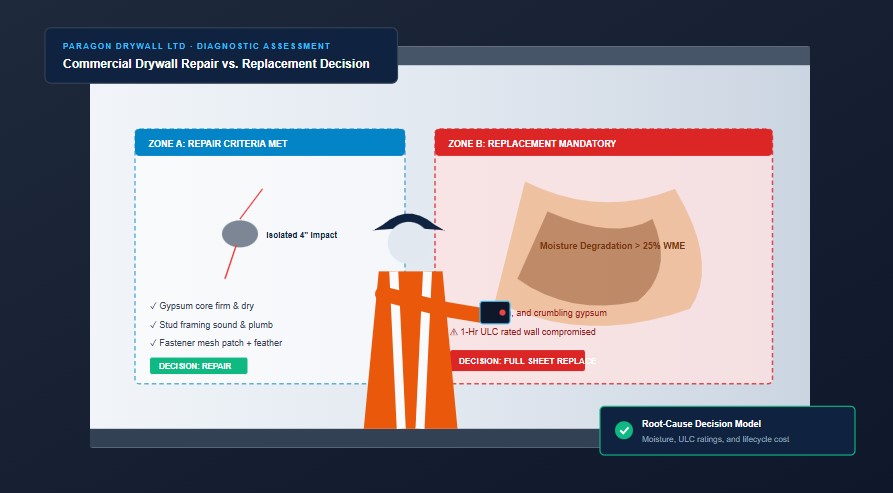
A commercial drywall contractor repairs drywall when damage is localized, the board and framing are sound, there is no moisture and no fire or sound rating is affected. Replacement is the better choice when damage is widespread, wet, mouldy, sagging or crumbling, when a rated assembly is compromised, or when repairs keep failing.
Why the Repair or Replace Decision Matters
The wrong choice is expensive either way. Patching a wet or structurally failing gypsum wall conceals underlying rot, compromises acoustic performance, and frequently triggers microbial mould growth or failed building inspections. Conversely, ripping out an entire partition that merely requires a precision California patch or re-taping wastes precious capital, generates unnecessary construction dust, and creates avoidable downtime for tenants. A clear, forensic decision process protects your budget, your schedule, and the long-term asset value of your commercial building.
Our Five-Step Decision Process
Rather than guessing or defaulting to the most expensive scope, our site superintendents evaluate damaged drywall assemblies through a rigorous five-step diagnostic framework:
1. Find the Cause of the Damage
Impact damage, a slow plumbing pinhole leak, building settlement, truss uplift, and improper screw placement all require fundamentally different remedies. We identify and isolate the root cause first because skimming compound over an active leak or moving timber framing guarantees repeat failure within months. Learn more about recurring site issues in our comprehensive guide to common drywall problems and solutions.
2. Measure the Extent
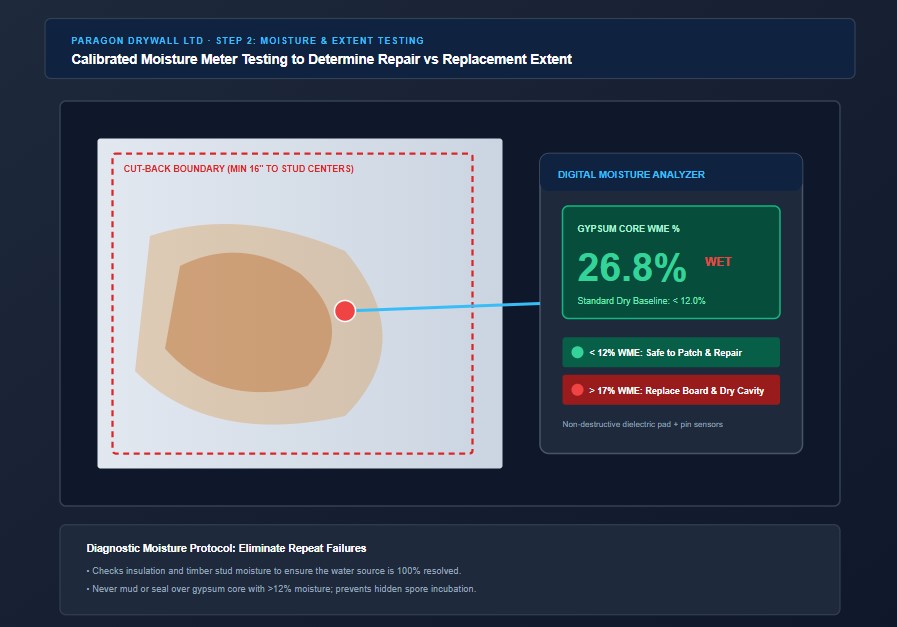
We physically probe the gypsum core with non-destructive acoustic hammers, inspect fastener tension, and utilize calibrated digital moisture meters across a 360-degree perimeter. In Metro Vancouver's damp climate, water often wicks upward inside cavity insulation 12 to 24 inches beyond visible surface staining.
3. Check the Assembly and Its Rating
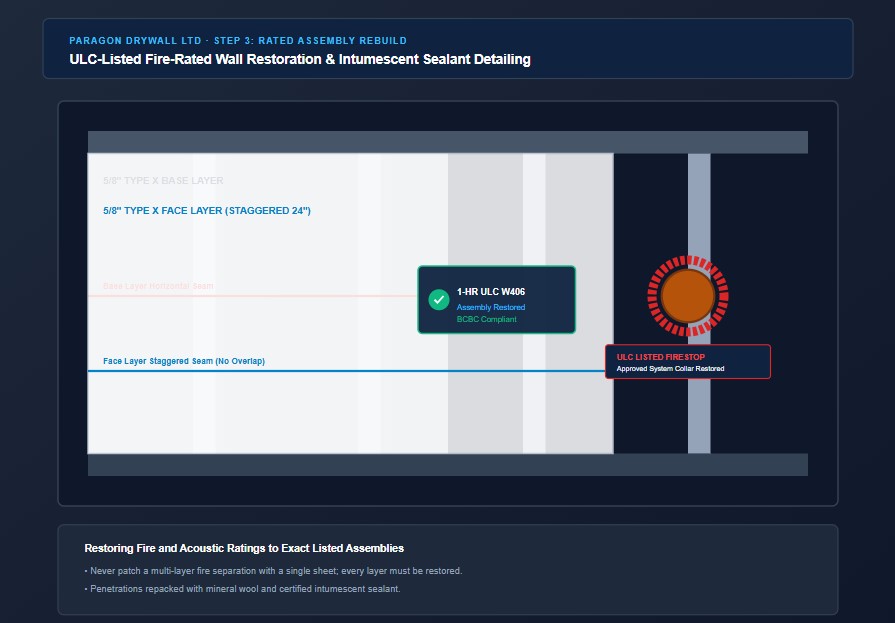
Our team at Paragon Ltd reviews architectural blueprints to confirm whether the damaged partition is a 1-hour or 2-hour ULC fire-rated separation, an STC 50+ acoustic party wall, or a designated wet-area assembly. A rated wall cannot be casually patched with standard compound; it must be rebuilt using matching 5/8-inch Type X boards, staggered plies, acoustic seals, and certified intumescent firestop collars. Always confirm compliance requirements with your structural consultant and the BC Building Code.
4. Compare the Options
We compare surgical patching against full-sheet replacement across structural durability, direct labor cost, total cure and drying time, and disruption to building occupants. Crucially, we analyze how seamlessly each approach will blend with existing paint sheens under critical raking light, providing property managers with transparent written trade-offs.
5. Recommend, Document and Confirm
We present a formal written recommendation accompanied by high-resolution site photographs, locking in agreed scope and pricing before cutting into walls. When unexpected issues arise once a cavity is opened—such as hidden mold, unbacked pipes, or corroded steel framing—our estimators follow structured change protocols. For more details, talk to our team at Paragon Drywall Ltd.
Repair vs Replace: A Quick Guide
Use this reference table to evaluate common drywall damage scenarios across commercial, retail, and multi-residential facilities:
| Situation | Usually repair | Usually replace |
|---|---|---|
| Small holes, dents or cracks | Yes, if surrounding board is firm and plumb. | Only if gypsum core is shattered or crumbling. |
| Nail pops or loose tape | Yes (re-fasten, cut loose tape, re-bed in setting mud). | No, unless framing behind has permanently twisted. |
| Water stain (leak fixed, area dry) | Often, after digital moisture checks confirm <12% WME. | If board is soft, swollen, delaminating, or mouldy. |
| Large damaged area (> 4x4 feet) | Sometimes, if damage is purely cosmetic finish wear. | Often, for superior plane flatness and consistent finish. |
| Fire-rated or sound-rated damage | Only if repaired to the listed ULC assembly. | If core layers, stagger lines, or framing are compromised. |
| Repeated failure in same spot | Rarely; patching fails if framing is still flexing. | Often, after rebuilding substrate and adding expansion joints. |
Signs Repair Is Enough
A targeted patch, skim, and prime application is typically the fastest and most cost-effective solution when:
- Damage is small, isolated, and under 12 inches across.
- The surrounding gypsum board is rigid, and wood or steel stud framing is solid.
- Moisture meters confirm the gypsum core is completely dry (< 12% WME), with zero fungal or mold spores.
- The wall assembly has no compromised fire-resistance or acoustic sound ratings.
- The patched area can be feathered wide (10–14 inches) to match existing wall texture seamlessly under raking light.
Signs You Should Replace
Attempting a patch on severely compromised gypsum is false economy. You should replace full panels when:
- Gypsum board feels spongy, soft, visibly swollen, or crumbles under light finger pressure.
- Active mold colonization or recurrent water staining is present inside the wall cavity.
- Damage spans multiple stud bays, covers a large surface area, or compromises an entire ceiling plane.
- Light-gauge metal studs have rusted or timber studs behind the drywall have warped, rotted, or split.
- Previous cosmetic patches have cracked or popped repeatedly in the exact same location.
- A ULC-rated fire partition or acoustic STC demising wall has had penetration collars or inner layers removed.
Special Cases: Rated Walls and Older Buildings
Commercial drywall repairs in Vancouver often involve special regulatory and environmental safeguards:
In older commercial properties and heritage buildings constructed prior to 1990, joint compounds, textured ceiling finishes, and plaster layers may contain asbestos or lead. Our superintendents require a formal Hazardous Materials Survey before sawing or mechanically sanding existing drywall.
Where plumbing floods result in visible mold exceeding 10 square feet, certified remediation professionals must isolate the zone under negative air pressure and clear all biological contamination before drywall reconstruction begins. Always review WorkSafeBC guidelines and municipal hazardous waste regulations prior to disturbing older walls.
What Affects Cost, Time and Disruption
When preparing detailed proposals for property managers and general contractors, our estimators evaluate five objective criteria:
- Size and location of the damaged area: High-ceiling atrium walls or cramped mechanical shafts require specialized scaffolding and rigging.
- Board type and rating of the wall: Standard 1/2-inch board vs double-layer 5/8-inch Type X fire-rated assemblies with acoustic sealant beads.
- Access, working hours and tenant disruption: After-hours work in occupied office towers requires HEPA air filtration and rapid dust-barrier containment.
- Drying and cure times for compound: Setting-type chemical muds accelerate multi-pass schedules, whereas humid coastal weather requires active dehumidification.
- Finish level and paint sheen: Walls with glossy enamel topcoats or critical raking light require full-wall Level 5 skim coats to prevent flashing.
What to Ask Your Commercial Drywall Contractor
Before authorizing drywall repair or replacement on your Vancouver commercial site, ask these five qualifying questions:
- How will you diagnose the root cause of the damage before starting? Ensure they investigate framing movement, moisture intrusion, and fastener depth rather than simply skimming mud over the crack.
- Will you explain in writing why you recommend repair versus replacement? Professional subcontractors provide transparent diagnostic photos and clear cost-benefit analyses.
- How will you protect the wall's fire or sound rating? Confirm they understand ULC design assemblies, staggered board plies, and approved firestop caulking.
- How will you match the existing wall texture and finish level? Look for contractors who inspect finishes under raking light and apply PVA primer before turnover.
- Are your WorkSafeBC clearance and liability insurance current? Verify active WorkSafeBC coverage in good standing and at least $5,000,000 in commercial general liability insurance.
Local Experience You Can Verify
Paragon Drywall Ltd. is a woman-owned commercial drywall subcontractor serving Vancouver, the Lower Mainland, and the Fraser Valley. With over 15 years of continuous commercial operations, we execute projects from ground-up installations to intricate repairs in occupied corporate and institutional buildings.
Recent successful repair-or-replace assignments include rapid flood remediation and fire separation restoration on landmark multi-family towers such as Station Square Tower in Burnaby and high-traffic institutional fit-outs at Alexander College in Vancouver. We maintain WorkSafeBC clearance in good standing, carry comprehensive $5M commercial liability coverage, and strictly adhere to Gypsum Association GA-214 finishing standards.
Get a Clear Repair or Replace Recommendation From a Commercial Drywall Contractor
Not sure whether your damaged wall needs a targeted patch or complete board replacement? Partner with a commercial drywall contractor who explains the reasoning clearly. Send us photos of the damage, building location, and project schedule for a fast, diagnostic assessment and firm written estimate.
Frequently Asked Questions
Quick answers to common questions about repairing versus replacing drywall on Vancouver commercial properties.
How do you decide whether to repair or replace drywall?
A commercial drywall contractor finds the cause of the damage, measures how far it extends, checks the wall's fire and sound rating, and compares repair and replacement by durability, cost, time and disruption. Repair suits small, dry, sound areas; replacement suits widespread, wet or failing board.
When should drywall be replaced instead of patched?
Replace drywall when it is soft, swollen, crumbling, sagging or mouldy, when damage covers a large area, when framing behind it is damaged, when a rated assembly is compromised, or when repairs have failed more than once.
Can water-damaged drywall be repaired?
Sometimes. If the leak is fixed, the board is firm and everything is fully dry, a repair may be enough. Soft, swollen or mouldy board should be replaced, and larger mould areas should be assessed by a qualified remediation firm first.
Does a fire-rated wall need to be replaced after damage?
Not always, but it must be repaired or rebuilt to its listed assembly, with the correct board, layers and firestop. Confirm requirements with your consultant and the local building authority before altering rated walls.
Is repairing drywall cheaper than replacing it?
Usually, for small localized damage. For widespread or repeated damage, replacement can cost less over time because it avoids repeat repairs. A contractor should explain the cost, schedule and disruption of each option in writing.
Does Paragon Drywall serve areas outside Vancouver?
Yes. Paragon Drywall Ltd. Company serves commercial and multi-residential projects across the Lower Mainland and the Fraser Valley.