
Case Study · On-Site Problem Solving & Schedule Recovery
A Construction Challenge Our Commercial Drywall Contractor Team Solved on Site in Vancouver
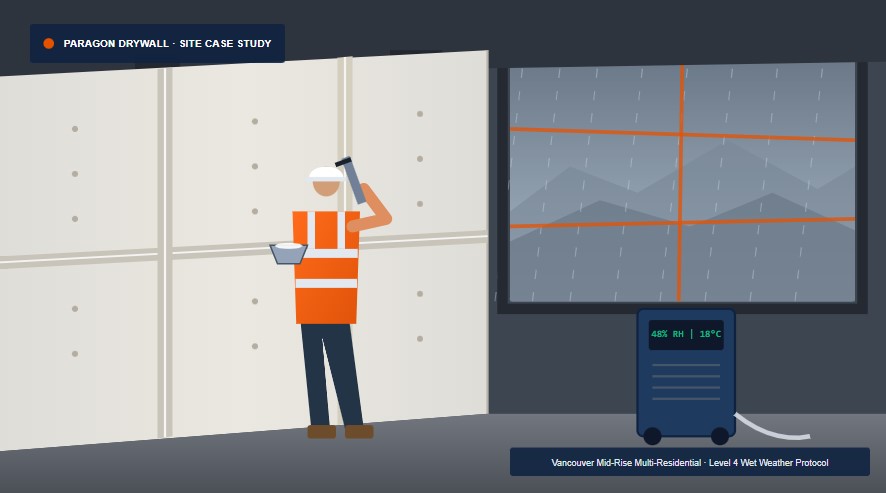
Every commercial drywall contractor says they solve problems on site. Here is an example of what that looks like. On a mid-rise multi-residential building in Vancouver, a stretch of wet weather arrived just as our crews were ready to tape and finish several floors, and the building envelope was not yet fully closed. This is how our team assessed the problem, weighed the options and kept the schedule moving without cutting corners on quality.
Quick Answer
We solved a wet-weather finishing delay by measuring temperature and humidity, adding temporary heat and dehumidification with the general contractor, using setting-type joint compound for early coats, resequencing floors and inspecting every coat before moving on. The finish met the specified level and the schedule stayed on track.
Project Snapshot
| Item | Detail |
|---|---|
| Building | Mid-rise multi-residential building in Vancouver |
| Our scope | Taping and finishing to Level 4 |
| Challenge | Wet weather with an incompletely enclosed building envelope |
| Floors affected | 5 floors |
| Our team | Foreman, finishing lead, quality control lead and 5 finishers |
| Client | James Smith |
The Challenge: Wet Weather and Slow-Drying Compound
Standard ready-mixed joint compound dries by evaporation, so proper drying relies entirely on ambient temperature, active airflow, and low relative humidity. During prolonged rainy spells in Vancouver, when exterior window openings are temporarily sealed with poly sheeting rather than permanent glazing, humidity levels regularly soar above 85% while temperatures plunge. Under these conditions, standard compound coats remain damp for days.
Slow drying stalls subsequent coats and paralyzes production. Rushing coats over incompletely dried mud invariably leads to joint cracking, delayed shrinkage, fastener shadowing, and surface blistering. Meanwhile, the prime painting contractor and finish flooring crews were scheduled to mobilize on the upper floors within days. Passing schedule delays up the chain was unacceptable; as an experienced commercial drywall contractor, our mandate was to engineer an immediate on-site solution.
What We Measured First
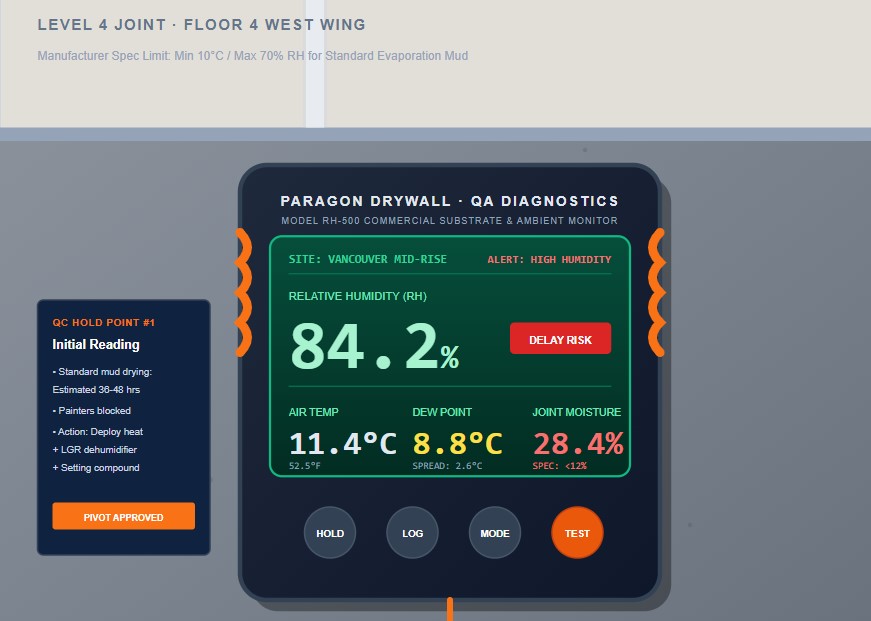
Before proposing mechanical interventions or material substitutions, our quality control lead documented physical baseline metrics across all affected zones:
- Air temperature and relative humidity on each floor using calibrated digital hygrometers.
- Dampness of embedded tape joints by touch, visual color shift, and non-destructive surface moisture meters.
- Open window, exterior patio door, and shaft areas to assess natural draft infiltration.
- The joint compound manufacturer’s minimum drying thresholds specified on the technical product data sheet (55°F / 13°C and <70% RH).
Data, not guesswork, decided what we did next.
The Options We Weighed
Our superintendent and finishing lead evaluated five tactical approaches, weighing immediate cost, schedule preservation, and structural finish risk:
| Option | Benefit | Risk |
|---|---|---|
| Wait for better weather | No added equipment or material cost | Severe project schedule delay, trade stacking downstream |
| Rush the coats | Looks faster in the daily log | Cracks, severe compound shrinkage, failed inspections, and costly rework |
| Temporary heat and ventilation | Dries coats evenly across the floor plane | Requires site power, fuel supply, and close trade coordination |
| Setting-type compound for early coats | Cures by internal chemical reaction, virtually unaffected by ambient humidity | Sets rapidly and is considerably harder to sand if over-applied |
| Heat, ventilation and setting-type compound together | Best overall control of cure times and surface quality | Requires rigorous planning, experienced finishers, and daily supervision |
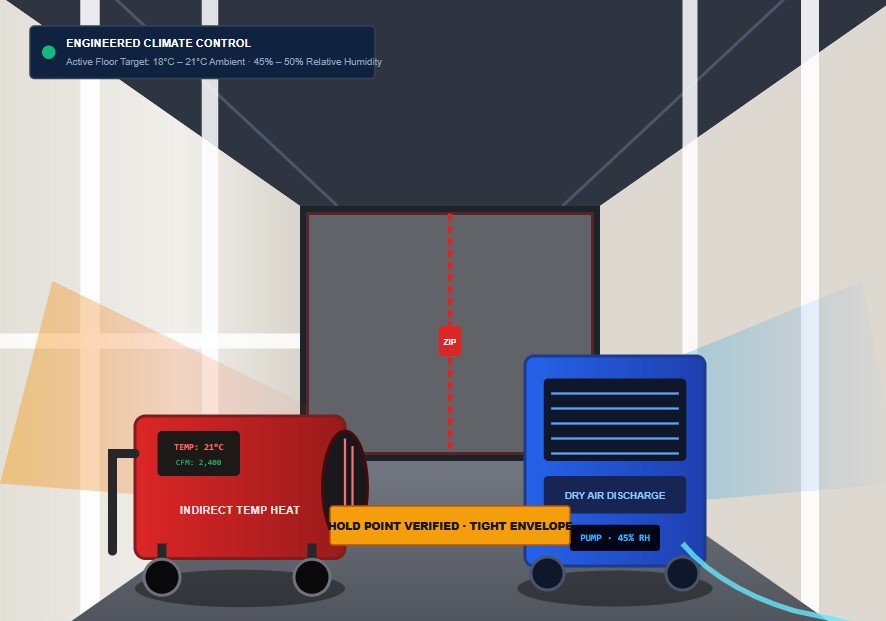
We chose the last option: combining controlled indirect heat, active dehumidification, and chemical-setting compounds for base coats.
Our Solution: A 6-Step Plan
- Agree the plan with the general contractor: We met with the GC superintendent, reinforced temporary poly on all unglazed window openings, scheduled indirect-fired propane heating units, and established mandatory hold points between coats.
- Add dehumidification and airflow on the active floors: Industrial Low Grain Refrigerant (LGR) dehumidifiers and axial air movers were positioned down central corridors to keep air circulating without blowing directly onto wet mud.
- Use setting-type compound for taping and first coats: We switched base coats and corner beads to high-strength chemical-setting powder compound (Durabond / Easy Sand 90), reserving lightweight air-dry topping compound only for the final skim.
- Resequence the floors: Crews were rotated so finishers worked in order of envelope readiness, completing the driest lower suites first while upper zones stabilized.
- Check every coat before applying the next: Our quality lead personally inspected each coat for cure completion, hardness, and flatness before releasing the zone to the next pass.
- Inspect under raking light to Level 4: Final sanded surfaces were surveyed with portable high-intensity halogen lamps parallel to wall surfaces to confirm Level 4 compliance per GA-214 standards.
Why Setting-Type Compound for Early Coats?
Unlike ready-mix compounds that release water into ambient air to harden, setting-type joint compounds harden through an internal chemical crystallization reaction akin to plaster. This chemical reaction occurs on schedule regardless of elevated humidity or chilly air. We utilized 90-minute setting compound for embedding paper tape and filling deep factory recess bevels, providing exceptional bond strength with virtually zero shrinkage. Because setting mud cures rock-hard and resists mechanical sanding, only our Paragon Drywall Ltd. Company's most experienced journeyperson finishers handled the application, wiping edges razor-thin to minimize final tooling.
How the Team Worked Together
Executing an intensive environmental turnaround on a five-floor commercial residential project requires clear command and accountability across all roles:
- Foreman: Coordinated temporary power drops, fuel deliveries, corridor access, and floor turnover milestones directly with the general contractor.
- Finishing Lead: Selected mix ratios, formulated work batches, and directed the five journeyperson finishers on application speed.
- Quality Control Lead: Measured moisture levels on each suite before coat release, holding sole authority to pause work if a room fell out of spec.
- General Contractor: Fast-tracked poly perimeter seals, supplied 208V power for dehumidifiers, and monitored fuel tanks 24/7.
- Everyone: Strictly adhered to WorkSafeBC respiratory protection guidelines, HEPA dust containment, and fuel safety protocols.
To see how our field teams integrate quality checks across earlier construction phases, read our guide on project walkthrough from framing to finishing.
Results and Lessons
Within 36 hours of activating indirect heat and dehumidification, relative humidity dropped from 86% to 48%, and ambient temperatures stabilized at a consistent 19°C. The setting-type base coats cured cleanly without edge cracking or shrinkage hollows, allowing our finishers to apply smooth, thin topping coats that dried predictably in overnight shifts.
All five floors passed city and architectural raking light inspections on the first walkthrough, enabling the painting subcontractor to mobilize exactly on their scheduled date.

The four core lessons applied to every Paragon project:
- Measure conditions before deciding: Rely on thermo-hygrometers and moisture meters rather than guesswork or calendar assumptions.
- Agree plans with the general contractor early: Transparent communication turns an unexpected weather delay into a collaborative engineering victory.
- Use the right material for the conditions: Deploy setting-type chemical-cure compounds when coastal humidity threatens evaporation timelines.
- Never skip drying time to save a day: Trapping moisture behind premature paint coats creates defects that cost tenfold to repair after occupancy.
Work With a Commercial Drywall Contractor Who Solves Problems on Site
Want a reliable subcontractor team that proactively plans for weather, trade conflicts, and strict schedule milestones? Learn more about our specialized commercial drywall contractor capabilities or explore our extensive multi-residential drywall services across Metro Vancouver, then request a detailed proposal with your drawings and timeline.
Frequently Asked Questions
Concise answers to common questions about wet-weather drywall installation and finishing in Vancouver.
How does wet weather affect drywall finishing in Vancouver?
Damp air slows the drying of standard joint compound, which can cause cracking and uneven joints. Temporary heat, ventilation and dehumidification help control drying.
What is setting-type joint compound?
It is a powder compound that hardens through a chemical reaction instead of evaporation. It is less affected by humidity but sets quickly and is harder to sand.
Can drywall be finished in cold or damp conditions?
Only within the manufacturer's limits. We follow the product data sheet and use temporary heat and ventilation to keep conditions suitable.
How does a commercial drywall contractor protect the schedule?
By measuring conditions early, agreeing plans with the general contractor, resequencing floors and using the right materials so work keeps moving without rework.