Facility Maintenance Guide · Occupied Commercial Environments
How We Approach Drywall Repairs in High-Traffic Commercial Spaces in Vancouver
Quick Answer: How Commercial Drywall Repairs Differ in Occupied High-Traffic Spaces
Repairing drywall in busy commercial spaces requires an entirely different methodology than new construction. As an experienced commercial drywall contractor in Vancouver, our approach centers on four non-negotiables: zero tenant disruption via overnight or weekend scheduling (7:00 PM to 6:00 AM), sealed negative-air dust containment preventing HVAC contamination, rapid chemical-setting compounds that cure within 45 minutes, and structural fortification using 5/8-inch abuse-resistant gypsum and heavy-gauge corner guards so walls withstand future impacts.
Commercial properties throughout Metro Vancouver—from prime retail flagships along Robson Street and corporate office towers in Downtown Vancouver to active outpatient healthcare centres along the Broadway corridor—operate under relentless daily physical demands. Elevator lobbies endure luggage scuffs; service corridors absorb repetitive impacts from pallet jacks and rolling delivery hampers; and clinic hallways face continuous contact from wheelchairs and rolling medical gurneys.
When drywall damage occurs in these operational environments, property and facility managers face a delicate dilemma. You cannot shutter a revenue-generating retail sales floor or evacuate an occupied corporate headquarters for multiple days while waiting for traditional drying mud to cure. Nor can you tolerate drywall dust circulating into cleanroom environments or triggering fire duct smoke sensors.
Hiring a dedicated commercial drywall contractor like Paragon Drywall Ltd. ensures repairs are planned, executed, and completed with surgical precision. Here is the exact engineered protocol our field crews follow to restore damaged walls rapidly, cleanly, and permanently across Metro Vancouver commercial facilities.

Why High-Traffic Commercial Drywall Repairs Demand a Specialized Approach
In an unoccupied new construction rough-in, drywall crews work freely with wide access, open ventilation, and standard air-drying all-purpose joint compounds that take 24 hours per coat to evaporate. In an occupied commercial building, attempting to use residential or new-build methods guarantees operational friction and recurring wall failure.
High-traffic commercial repairs present three non-negotiable logistical challenges that require commercial-grade intervention:
- Air Quality & HVAC Vulnerability: Airborne gypsum dust contains fine crystalline particles. If an uncontrolled repair occurs near return-air plenums, dust will travel into tenanted suites, computer server rooms, or optical equipment, leading to tenant complaints and costly duct cleaning claims.
- Business Continuity & Revenue Protection: Vancouver retail stores, restaurants, and medical clinics cannot afford day-time closures, audible demolition hammering, or unsightly caution tape while customers are on premise.
- The "Patch-and-Fail" Cycle: Patching an impact fracture on an elevator vestibule corner with soft 1/2-inch regular drywall and standard paper bead simply ensures that the next luggage cart will blow the corner open again within three weeks.
To prevent these failures, commercial repairs require dedicated equipment, specialized materials, and rigorous containment protocols.
Our 6-Step Protocol for Drywall Repairs in Occupied Commercial Spaces
Whether repairing high-impact wall gouges in a downtown condominium lobby or retrofitting service hallways in a Burnaby distribution center, Paragon Drywall executes a proven 6-step containment and repair process:
Pre-Job Site Assessment & Root-Cause Inspection
Before swinging a utility knife, our project supervisor inspects the damaged wall assembly. We check the condition of internal steel stud framing, inspect for hidden plumbing or electrical conduits, verify if the wall is an acoustical partition or a ULC-rated fire separation, and use non-destructive pinless moisture meters. Understanding why the wall failed (e.g., lack of solid wood/steel backing, stud deflection, or heavy door swings without stops) ensures the repair addresses the underlying cause rather than simply cosmetically covering a recurring defect. If deeper issues are found, see what we do when repairs uncover more problems.
Off-Hours Scheduling & Phased Mobilization
To eliminate disruption to commercial tenants, the vast majority of high-traffic repairs are scheduled for night shifts (7:00 PM to 6:00 AM) or weekend time windows. Our crews mobilize punctually, sign in with on-site building security, and establish designated material transit routes via service elevators. We protect high-end marble or carpeted thoroughfares with heavy-duty Ram Board surface runners with vapor-permeable seams.
Airtight Dust Isolation & Negative-Air Containment
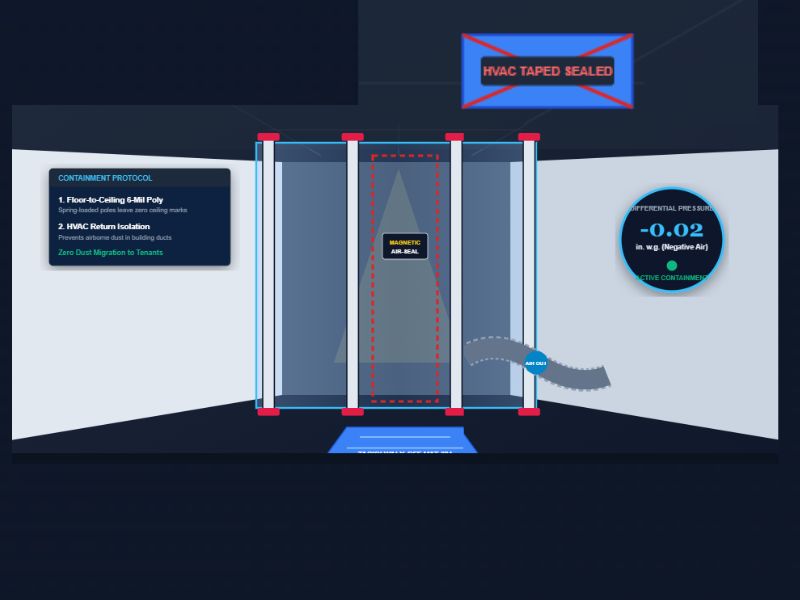
Dust containment is the hallmark of a professional commercial drywall contractor. We erect heavy 6-mil flame-retardant polyethylene barriers suspended from floor-to-ceiling spring-loaded tension poles with non-marking rubber pads. Magnetic self-closing zipper doors allow technician access while preventing dust escape. We isolate nearby HVAC return diffusers with magnetic film and run portable 500-CFM HEPA air scrubbers that maintain continuous negative air pressure inside the containment envelope. Sticky tacky walk-off mats at every portal capture dust from work boots.
Rapid-Cure Setting Compounds ("Hot Mud")
Standard pre-mixed joint compound relies on air evaporation, drying in 12 to 24 hours per coat under Vancouver's high relative humidity. To complete seamless Level 4 and Level 5 finishes in a single overnight shift, our tapers use chemical-setting compounds (such as Sheetrock Durabond or Easy Sand 20/45). These compounds cure through a chemical crystallization process in 20 to 45 minutes regardless of site humidity, generating exceptional surface hardness with zero shrinkage or edge cracking.
Reinforcement with Abuse-Resistant Board & Heavy-Gauge Corner Beads
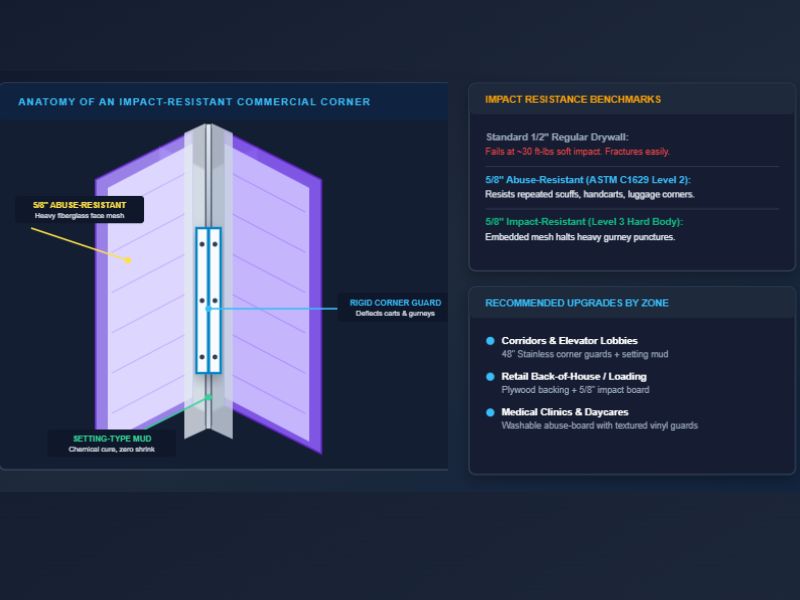
When rebuilding damaged wall sections in high-impact zones, we replace weak 1/2-inch gypsum with 5/8-inch abuse-resistant or impact-resistant gypsum panels (ASTM C1629 Level 2/3 rated). These panels feature ultra-dense gypsum cores infused with fiberglass strands and heavy facers. We install solid 16-gauge steel track backing behind door handles and equipment mounts. Exterior corners receive heavy-gauge vinyl-composite or stainless steel corner beads embedded in setting compound, capable of deflecting cart impacts that would shatter standard paper tape.
Dustless HEPA Sanding, Raking-Light Inspection & Priming
Finishing is carried out using random orbital power sanders connected directly to certified HEPA vacuum extractors, capturing 99.5% of sanding particulates at the cutting pad. Our lead finisher audits every seam under low-angle 500-watt halogen raking light to verify flat planes and seamless feathered perimeters. Finally, we apply a high-solids, low-VOC commercial primer sealer to equalize surface porosity, ensuring the paint topcoat displays uniform sheen without flashing or haloing.
High-Traffic Commercial Environments We Service Across Vancouver
Different commercial environments experience unique stress factors. As a versatile commercial drywall contractor, we tailor our boarding thickness, corner profiles, and finishing schedules to each facility's operational realities:
| Facility Type | Common Damage Causes | Recommended Material Specification | Optimal Shift Timing |
|---|---|---|---|
| Office Towers & Elevator Lobbies | Luggage corners, briefcase abrasions, maintenance cart strikes | 5/8" Type X with high-impact vinyl corner guards, Level 5 skim | Overnight (7:00 PM – 5:30 AM) |
| Retail Flagships & Boutiques | Rolling clothes racks, display fixture anchors, fitting room doors | 5/8" Abuse-resistant board, heavy wood/steel backing plates | After store close (9:00 PM – 7:00 AM) |
| Medical & Dental Clinics | Wheelchair footrests, mobile IV poles, sanitizing chemical washdowns | Impact-resistant board with mold/mildew resistant facers (ASTM C1629 Level 3) | Friday evening to Sunday weekend mobilization |
| Multi-Residential Corridors | Tenant move-ins, bicycle pedals, stroller wheel hubs | Reinforced composite beads, washable setting compound, scuff-resistant primer | Phased weekdays (9:30 AM – 4:00 PM) or weekend shifts |
| Restaurants & Commercial Kitchens | Bussing bins, high humidity, thermal fluctuations, chair backs | 5/8" Water-resistant Type X board with surface-mounted stainless kickplates | Early morning hours (2:00 AM – 9:00 AM) |
The Overnight Commercial Drywall Repair Schedule: What Happens Between 7 PM and 6 AM
Facility managers frequently ask how our team can complete comprehensive drywall patching, multi-coat finishing, and priming within an 11-hour overnight window. Here is our step-by-step operational timeline:
Crew checks in with building security; lays Ram Board floor protection from loading dock to repair zone; erects ZipWall dust barrier; seals HVAC returns; powers on HEPA air scrubber.
Precision plunge-cut removal of fractured drywall; inspection of internal wiring and steel studs; installation of 2x4 wood or 20-gauge steel backing; installation of 5/8" abuse-resistant drywall patch screwed at 8" on-center.
Application of high-strength setting compound embedded with high-tensile fiberglass mesh tape; installation of rigid corner bead; forced heat drying; application of second feathering coat with 45-minute setting mud.
Application of ultra-smooth finishing compound feathered 14 inches past perimeter; low-velocity warm air circulation fans deployed for uniform curing.
Shrouded vacuum sanding with 220-grit abrasive pads; inspection with 500W raking light to eliminate tool marks; application of fast-drying, low-VOC commercial bonding primer.
Wipe-down of containment poly; removal of ZipWall poles and sticky mats; HEPA vacuuming of entire transit corridor; final walkthrough with building security officer; site left 100% clean and ready for morning business.
How to Prevent Recurring Drywall Damage in Commercial Corridors
While our team provides rapid emergency patching, our primary goal as your long-term commercial drywall contractor is to eliminate recurring maintenance costs. During every repair walkthrough, we evaluate structural upgrades to shield high-risk wall surfaces:
Facility Manager's Wall Reinforcement Checklist
- Install Surface-Mounted Corner Guards: In high-traffic service corridors, install 2-inch to 3-inch 16-gauge brushed stainless steel or textured high-impact vinyl corner protectors extending 48 inches above the finished floor.
- Specify 5/8" Impact-Resistant Board Up to Chair-Rail Height: Rather than replacing the full wall height, install impact board across the bottom 48 inches of high-traffic hallways where 95% of impacts occur.
- Add Internal Continuous Wood or Steel Backing: Ensure solid 2x6 or 16-gauge steel track backing is installed behind all wall-mounted doorstops, panic bars, fire extinguishers, and directory boards.
- Upgrade to Rigid Vinyl Composite Beads: Replace easily dented traditional metal-paper corner beads with flexible vinyl composite beads that absorb direct shocks without denting or flaking paint.
- Use High-Durability Scuff-Resistant Coatings: Pair professional drywall repairs with commercial-grade scuff-resistant interior acrylic coatings (such as Benjamin Moore Scuff-X or Sherwin-Williams Scuff-Hide).
Five Questions Facility Managers Should Ask a Commercial Drywall Contractor Before Awarding Repairs
Not all drywall companies are equipped for commercial properties in operation. Before handing keys or after-hours security badges to a contractor, verify these five qualifications:
-
Do you use dedicated HEPA negative-air dust containment?
Why it matters: Standard shop vacs or open plastic sheets without negative air exhaust allow microscopic gypsum dust to penetrate elevator shafts and HVAC return ducts. -
Do you utilize chemical-setting compounds for single-shift curing?
Why it matters: Contractors relying on all-purpose bucket mud will either rush recoats while damp—causing paint blisters and joint cracking—or stretch a simple patch into a multi-day disruption. -
Can you provide continuous WorkSafeBC clearance and $5M commercial general liability insurance?
Why it matters: Property management companies and commercial strata councils require active WorkSafeBC clearance in good standing and comprehensive liability coverage before granting building access. -
Can you upgrade damaged areas to ASTM C1629 abuse-resistant boards?
Why it matters: A quality contractor solves the root problem rather than just selling you the same repair again next quarter. -
Do you self-perform after-hours repairs with certified in-house crews?
Why it matters: Subcontracting overnight repair work to unvetted day-laborers creates security risks, inconsistent finish quality, and missed morning turnover deadlines.
Verified Credentials: Why Metro Vancouver Chooses Paragon Drywall Ltd.
Paragon Drywall Ltd. is a woman-owned commercial and multi-residential drywall subcontractor with 15+ years of continuous operations across Vancouver, the Lower Mainland, and the Fraser Valley.
- Landmark Project Experience: Proven craftsmanship on premier towers and institutions, including Station Square Tower in Burnaby and Alexander College in Vancouver.
- Safety & Compliance: WorkSafeBC clearance in good standing, comprehensive $5,000,000 commercial general liability insurance, and strict site safety management.
- Quality Standards: Strict adherence to Gypsum Association GA-214 levels of finish and ULC-listed firestop and acoustical separation assemblies.
- Direct Accountability: We self-perform commercial renovations and repairs with dedicated, experienced journeymen tapers and boarders.
Frequently Asked Questions About Commercial Drywall Repairs
Can commercial drywall repairs be completed overnight without disrupting tenants?
Yes. Paragon Drywall routinely deploys after-hours repair crews between 7:00 PM and 6:00 AM across Metro Vancouver. By utilizing fast-setting chemical compounds (Durabond 20/45) and floor-to-ceiling negative air containment, we complete boarding, multiple mud coats, dustless sanding, and commercial primer before morning staff and visitors arrive.
How do you keep fine drywall dust from getting into our commercial HVAC systems?
We install sealed tension-pole plastic enclosures (ZipWall) around the work area, magnetically seal HVAC return diffusers, run portable HEPA air scrubbers under negative pressure, and connect sanders directly to HEPA extractors. Tacky walk-off mats at every entry point prevent dust tracking across floor finishes.
What is the difference between standard drywall and abuse-resistant drywall in high-traffic areas?
Standard 1/2-inch drywall has a soft gypsum core that punctures easily under light impact (~30 ft-lbs). 5/8-inch abuse-resistant and impact-resistant boards feature high-density gypsum cores, fiberglass facers, and embedded mesh backing designed to withstand heavy pallet carts, gurneys, door swings, and continuous foot traffic without cracking.
How do you blend repair patches into existing textured or painted walls?
We feather joint compound outward 12 to 18 inches past the repair perimeter to create a seamless taper. Our tapers recreate original texture profiles (smooth Level 4/5, light orange peel, knockdown) and inspect every patch with low-angle raking light before applying high-solids primer to eliminate flashing. For details on common wall issues, review our guide to common drywall problems and solutions.
What happens if your crew discovers water damage or missing firestopping during repair?
We immediately halt demolition, isolate the issue, and document the root cause with photos and moisture meter readings. If fire-rated separations or plumbing leaks are compromised, we notify property management and restore the wall according to Vancouver Building By-law (VBBL) and ULC-listed firestop assembly standards.
Why should facility managers choose a dedicated commercial drywall contractor rather than a general handyman?
A specialized commercial drywall contractor carries dedicated after-hours crews, commercial negative-air containment equipment, WorkSafeBC coverage in good standing, $5M commercial general liability insurance, and the structural expertise required for fire-rated demising partitions and heavy-traffic durability upgrades.
Partner with Vancouver's Trusted Commercial Drywall Contractor
Need overnight repairs in an active commercial building, lobby, or retail space? Let Paragon Drywall Ltd. inspect the damage, establish certified dust containment, and restore your walls with zero disruption to your tenants.