Multi-Residential Construction Guide · Finishing Standards
How We Maintain Consistent Drywall Finishes Across Multiple Apartments in Vancouver
A consistent drywall finish is what separates a well-built apartment building from one that opens with a long deficiency list. When dozens of suites share one specification, every wall should look identical under the same light, whether it is unit 204 or unit 1108. At Paragon Drywall, a woman-owned commercial drywall contractor serving Vancouver and the Lower Mainland, we treat consistency as a system, not a hope. Here is how we keep every apartment uniform, from the first board to final inspection.
Quick Answer: Achieving Uniform Wall Finishes in Every Suite
We maintain a consistent drywall finish across multiple apartments by following one written finish standard (usually Level 4), approving a mock-up suite, using the same materials and tools, keeping crews on repeating floor plans, controlling site conditions, and inspecting every suite under raking light before paint.
Why a Consistent Drywall Finish Matters in Multi-Residential Buildings
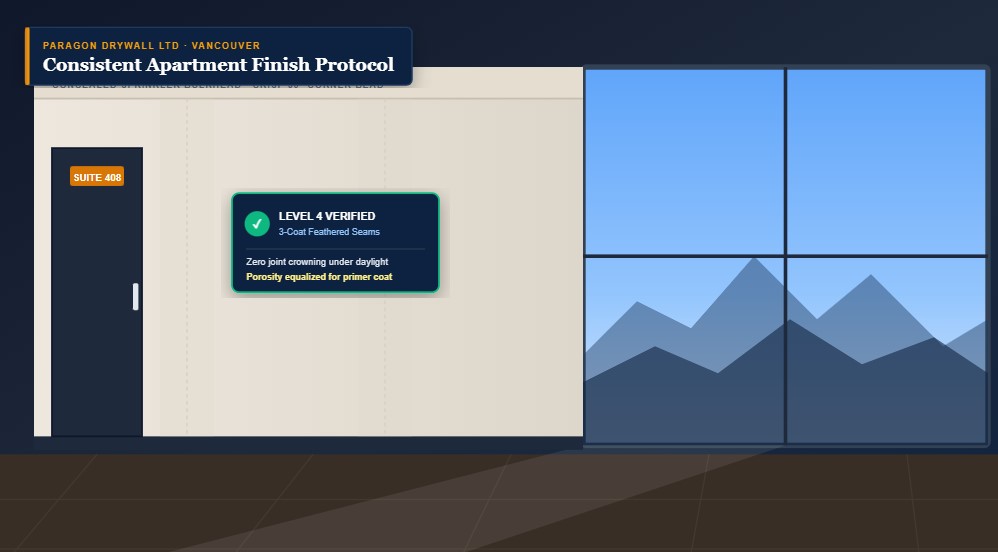
Apartment buildings are judged suite by suite. A tenant or buyer never compares your work to the building average; they compare it to the unit next door. Small differences in joint flatness, sanding or surface texture show up as paint flashing, ghosting joints and touch-up requests. Each one costs the general contractor time before occupancy. Consistency protects schedules, painter productivity and reputation.
In Vancouver multi-residential towers, daylight sweeps across wide living room partitions from floor-to-ceiling windows. If one suite received a three-coat feathered drywall finish while an adjacent suite was rushed with two thin passes, critical morning grazing light instantly reveals joint ridges and fastener shadows. Establishing an unyielding quality control process ensures every suite passes handover with zero paint touch-up delays.
Our 7-Step Process for Consistent Drywall Finishing Across Apartment Units
To guarantee identical wall quality from Level 2 to the penthouse floor, our team executes a structured 7-step finishing protocol:
Set the Finish Level in Writing
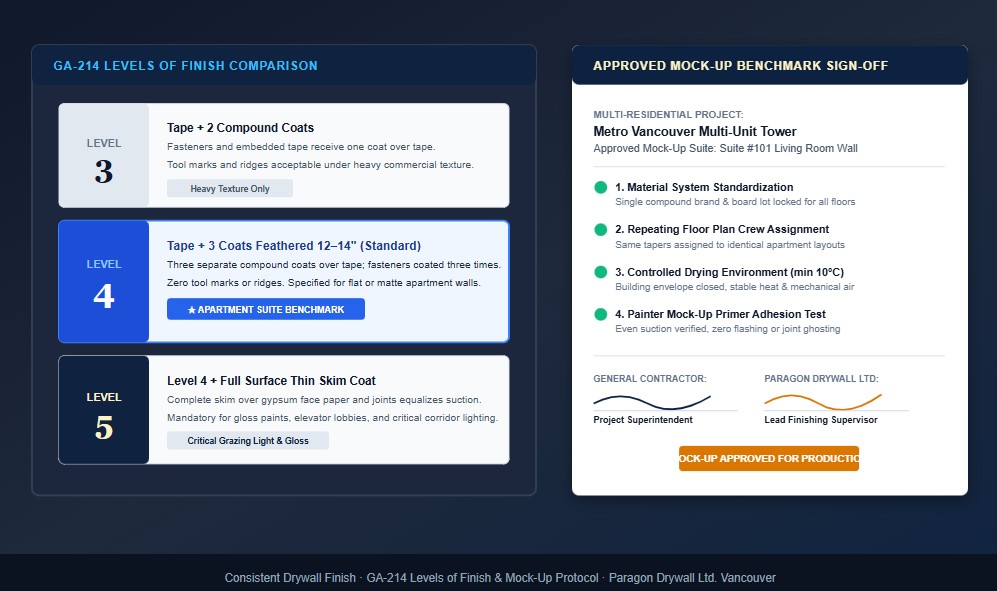
We confirm the specified level of finish against the Gypsum Association's GA-214 levels of finish before work starts, leaving zero ambiguity between trade partners.
Approve a Mock-Up Suite
One sample wall or suite, signed off under final lighting by the general contractor and painter, becomes the visual and tactile benchmark for all remaining suites.
Standardize Materials
One board type, one compound system and one set of tools per project. We eliminate material batch variables across floors.
Assign Crews by Floor Plan
The same team finishes repeating layouts. Finishers who master the corner returns in Unit Type 'A' stay on Unit Type 'A' throughout the entire building.
Control Site Conditions
Stable heat, mechanical ventilation and full drying time between coats ensure chemical curing without joint shrinkage or micro-cracking.
Inspect Under Raking Light
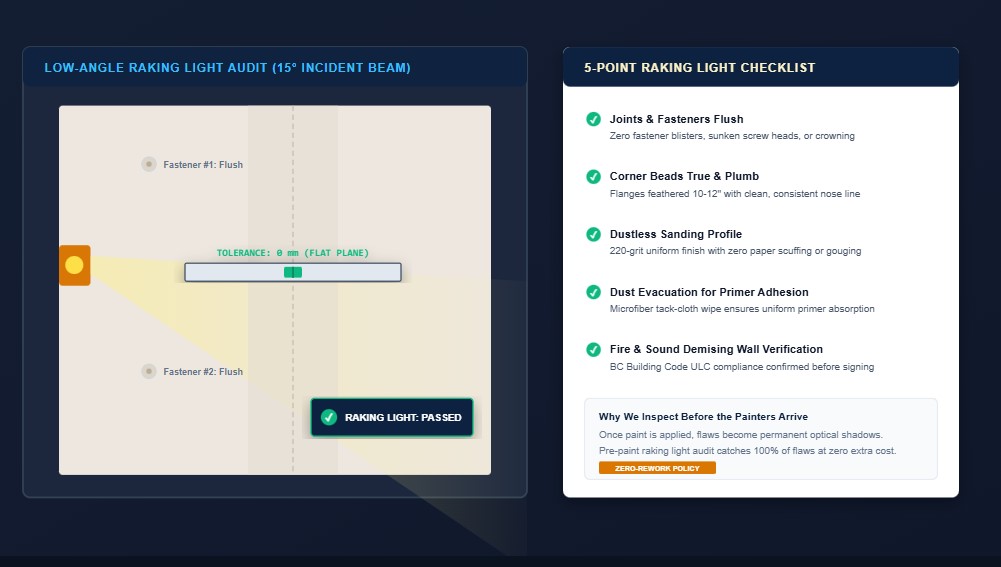
Every suite and ceiling is audited with a low-angle halogen beam before primer application, catching tool marks that standard overhead bulbs hide.
Correct and Document
Defects are tagged with blue tape, repaired immediately, logged in our digital deficiency tracker, and verified before paint crews arrive on the floor.
Setting the Standard Before the First Board Goes Up
Most inconsistency starts on paper. If the drawings say "paint-ready" and nothing more, each crew reads that differently. We at Paragon Drywall Ltd. Company near you, ask for the exact level of finish, the paint sheen and the lighting conditions, because those decide how forgiving the wall will be. For suite walls and ceilings that receive flat or matte paint, Level 4 is the practical standard.
| Level of Finish | What It Involves | Typical Apartment Use |
|---|---|---|
| Level 3 | Tape embedded in compound plus two coats over joints and fasteners; tool marks and ridges acceptable | Walls scheduled to receive heavy commercial texture or heavy vinyl wallcoverings |
| Level 4 | Tape embedded plus three coats of compound over joints; fasteners coated three times; feathered 12–14"; zero tool marks | Standard for suite walls and ceilings receiving flat, matte, or eggshell paint or light texture |
| Level 5 | Level 4 plus a thin, continuous skim coat applied over the entire drywall face to equalize suction | Elevator lobbies, corridors with grazing wall-washer fixtures, or suites specified with semi-gloss and enamel paint |
Building an Approved Mock-Up
Before we scale up, we finish one wall or one suite and have the general contractor and painter review it under the lighting the finished unit will have. That sample becomes the reference every crew works to. Signing off on a physical mock-up suite eliminates subjective debates during final occupancy inspections.
Controlling Materials, Tools and Crews
One Material System per Project
Mixing compounds, tapes or board lots can change how a wall takes primer. We keep one compound system from a single manufacturer such as CGC, mix to the product data sheet, and store materials so they stay consistent. When water-to-powder ratios or compound formulations vary between suites, the rate of binder absorption changes, causing paint flashing and uneven gloss across walls.
Same Crews on Repeating Floor Plans
Towers repeat layouts, so we keep the same finishers on the same unit types. Technique stays steady from floor to floor, and our foreman checks the first completed suite on each level before the team moves on. By specializing in specific room configurations, our finishers develop muscle memory for complex bulkheads, window returns, and closet corners.
Managing Site Conditions in Vancouver's Climate
Vancouver's wet, humid months change how joint compound dries. Fast or uneven drying causes cracking and visible joints, while slow drying delays the schedule. We coordinate with the general contractor so the building envelope is closed, and we keep heat and ventilation stable. Manufacturers generally call for interior temperatures of at least 10°C during finishing and drying, and we always follow the specific product data sheet.
Quality Control: How We Inspect Every Apartment
We inspect each suite with a portable light held low against the wall, because that angle exposes flaws that overhead lighting hides. Our quality checklist covers:
- Joints and fastener heads flush: Smooth feathering 12 to 14 inches wide with zero ridges, pinholes, or tool gouges.
- Straight corner bead with clean edges: Flanges fully concealed and feathered flat to prevent shadow lines.
- Even sanding with no torn face paper: 220-grit dustless orbital sanding that preserves the integrity of the gypsum paper.
- Dust removed so primer absorbs uniformly: Microfiber wiping to prevent primer suction failure and paint peeling.
- Fire- and sound-rated assemblies: Demising partitions between suites built to the BC Building Code design, then finished to the identical Level 4 standard.
Defects are marked, repaired and re-checked before painters start.
Common Causes of Inconsistent Drywall Finish and How We Prevent Them
Understanding why finishes drift allows our superintendents to address root causes before defects emerge:
| Problem | Likely Cause | How We Prevent It |
|---|---|---|
| Paint flashing | Uneven surface porosity between joints and board face | Matching compound coats, uniform sanding, and high-opacity sealer primer application |
| Visible joints (ghosting) | Poor feathering width or uneven compound thickness | Wide 12–14" feathering with 12" curved trowels and mandatory low-angle raking-light audits |
| Ridges and tool marks | Rushed final coat or nicked, damaged trowel blades | Daily tool inspections, pristine stainless blades, and secondary sponge/orbital sanding checks |
| Joint cracking | Forced fast drying or poorly embedded tape | Controlled heating (min 10°C), stable humidity, and full bedding of high-tensile tape in setting compound |
Verified Credentials: Why Metro Vancouver Builders Trust Paragon Drywall Ltd.
Paragon Drywall Ltd. is a woman-owned commercial and multi-residential drywall subcontractor with 15+ years of continuous operations serving Vancouver, the Lower Mainland, and the Fraser Valley.
- Landmark Portfolio: Successfully completed large-scale multi-unit towers and institutional complexes, including Station Square Tower in Burnaby and Alexander College in Vancouver.
- Safety & Standing: Active WorkSafeBC clearance in good standing and comprehensive $5,000,000 commercial general liability insurance.
- Quality Discipline: Strict enforcement of Gypsum Association GA-214 finish levels and BC Building Code ULC fire-rated separation assemblies.
- Predictable Trade Handoffs: Pre-paint raking light inspections ensure paint contractors take over completed suites with zero punch-list delays.
Frequently Asked Questions
What drywall finish level is best for apartments?
Level 4 is the standard choice for apartment walls and ceilings that receive flat or matte paint. Level 5 suits gloss paint or harsh lighting.
How do you keep drywall finishes the same on every floor?
We use one written standard, an approved mock-up, one material system, consistent crews on repeating unit types and a raking-light inspection of every suite.
How long does drywall finishing take in a multi-unit building?
It depends on suite count, ceiling height and site conditions. Each compound coat must dry before the next, so we schedule finishing floor by floor with the general contractor.
Does Paragon Drywall work outside Vancouver?
Yes. We work across the Lower Mainland and Fraser Valley on commercial and multi-residential projects.
Get a Consistent Drywall Finish on Your Next Apartment Project
Planning a build in Vancouver? Explore our multi-residential drywall services or our work as a commercial drywall contractor, then request a quote with your finish specification, schedule and suite count.