Commercial Drywall · Lower Mainland & Fraser Valley
Drywall Finish Levels Explained: Level 0 to Level 5 for Commercial Projects
TL;DR
Drywall finish levels run from Level 0 to Level 5. They tell your crew how smooth a wall should be before paint or wallpaper. Level 4 works for most painted commercial walls. Level 5 adds a full skim coat for the smoothest look under bright light and glossy paint.
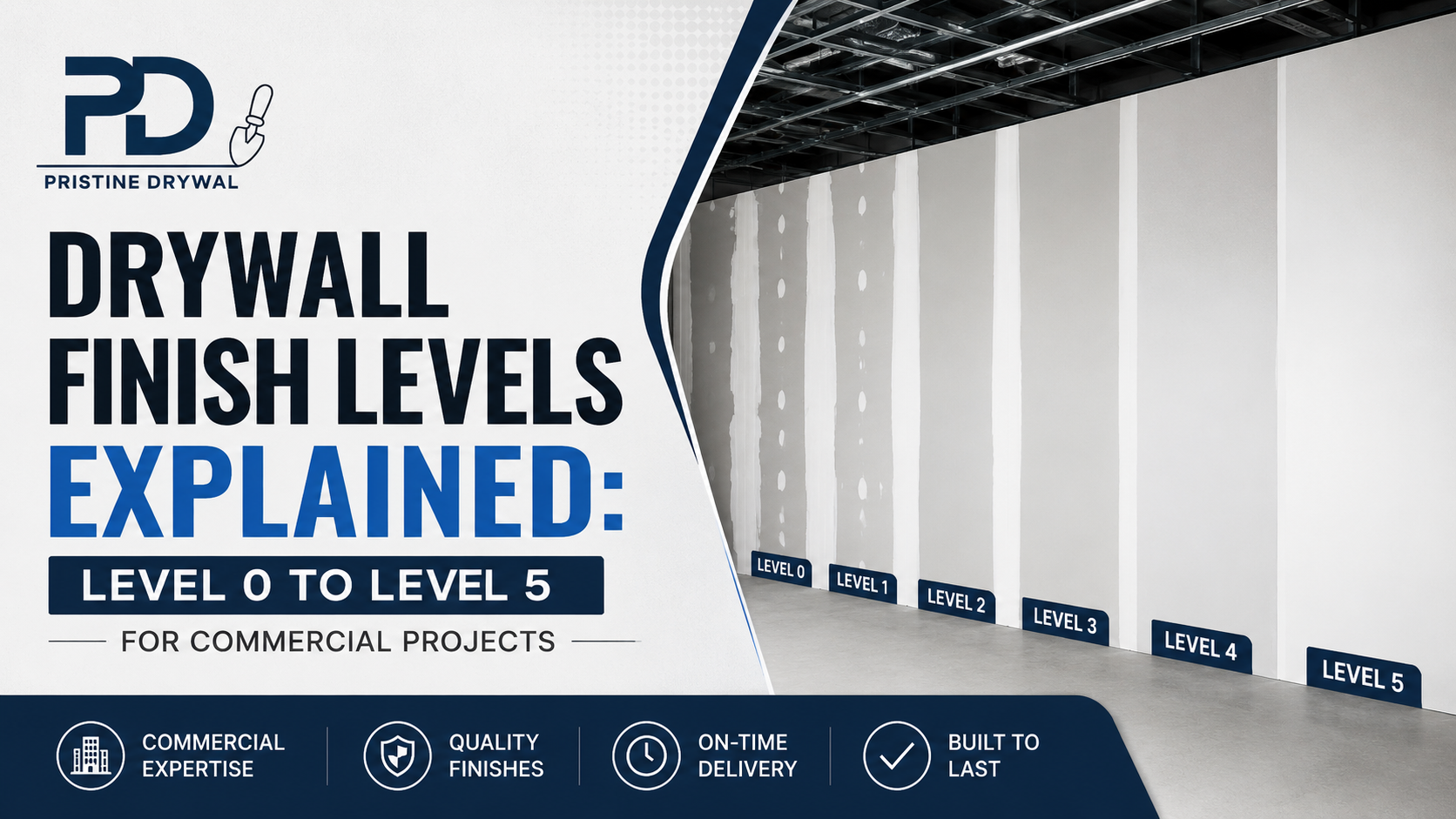
Drywall finish levels are a simple 0 to 5 scale. Each number tells your crew how much taping, mudding, and sanding a wall needs. This guide breaks down all six drywall finish levels for commercial jobs. It shows where each one fits and how to pick the right level for your British Columbia project.
Key Takeaways
- Drywall finish levels run 0 to 5, set by the Gypsum Association GA-214 standard.
- Level 4 suits most painted commercial walls with flat or eggshell paint.
- Level 5 adds a skim coat for the smoothest look under bright or glossy light.
- Warehouses and hidden walls often stop at Level 1 or 2 to save money.
- Picking the right level keeps your budget and your finish quality in line.
What are drywall finish levels?
Drywall finish levels are a 0 to 5 scale that shows how smooth a wall gets before paint or wallpaper. The Gypsum Association set this scale in its GA-214 standard. Builders across British Columbia use it to write clear specs.
Each level adds more coats of joint compound and more sanding. A higher number means a smoother wall and more labour. If you want the plain-English basics behind these coats, the public reference on drywall and its finishing covers the material well. Architects, contractors, and project managers all read the same scale, so everyone knows what the finished wall should look like before work starts.
What are the six drywall finish levels?
There are six drywall finish levels, from Level 0 to Level 5. Each step adds more taping, mudding, and sanding. Here is what each level means on a real job.

Level 0
Level 0 means no finishing at all. Your crew hangs the drywall and stops. No tape, no compound, no sanding. Builders use it for temporary walls or spaces that will change soon. You also see it in early construction before the design is final.
Level 1
Level 1 adds tape set in one coat of joint compound. The crew leaves tool marks and ridges on the surface. This level hides walls that nobody sees. Think service corridors, spaces above ceilings, or plenum areas in a warehouse.
Level 2
Level 2 covers the tape and screw heads with one coat of compound. The wall still shows tool marks. Crews use it in garages, storage rooms, and behind tile. Water-resistant board in a back room often stops right here.
Level 3
Level 3 adds a second coat over the tape and screws. The surface gets smoother but still shows some texture. This level fits walls that will get heavy texture spray or thick wall coverings. You see it in some warehouses and industrial spaces.
Level 4
Level 4 adds a third coat and a light sanding. The wall looks smooth and clean under normal light. This is the standard for most painted commercial walls. Offices, schools, and retail spaces use it every day. Flat and eggshell paint hide small flaws well at this level.
Level 5
Level 5 adds a thin skim coat over the whole wall. This coat fills every tiny pinhole and ridge. The result is the smoothest surface you can get. Bright lobbies, healthcare walls, and glossy paint all call for it. Harsh light and shiny paint show flaws, so Level 5 hides them.
Level 4 vs Level 5 drywall: which one do you need?
Level 4 works for most painted walls with flat or eggshell paint. Level 5 works for glossy paint, bright light, and high-end spaces. The main difference is the skim coat that Level 5 adds over the full wall.
| Feature | Level 4 | Level 5 |
|---|---|---|
| Coats of compound | Three coats | Three coats plus full skim coat |
| Surface look | Smooth | Smoothest |
| Best paint | Flat, eggshell | Semi-gloss, gloss |
| Labour needed | Less | More |
| Relative cost | Lower | Higher |
| Common use | Offices, schools, retail | Lobbies, healthcare, feature walls |

Raking light matters a lot here. Raking light hits a wall at a low angle and shows every bump and seam. Big windows, wall washers, and track lights all create it. If your design has raking light, spec Level 5. If not, Level 4 usually saves money and still looks great.
Where does each drywall finish level get used in commercial buildings?
Each drywall finish level fits a different space. Hidden walls get low levels. Painted rooms get Level 4. Bright and high-end rooms get Level 5. Here is how it plays out on Lower Mainland jobs.
Offices and colleges often run Level 4. Our crews finished walls at Alexander College and at Station Square in Burnaby at Level 4. Retail and feature spaces often need Level 5. We ran gallery-grade Level 5 walls for a Panago build in Chilliwack and for Winners and HomeSense stores. You can see the range in our commercial drywall installation and finishing work, which covers offices, retail, and institutional spaces across the region.

Warehouses and back-of-house areas stop at Level 1 or 2. Nobody paints a plenum or a storage wall to gallery grade. Matching the level to the room keeps the budget honest.
Healthcare and school walls sit in the middle and the top. Clinics with bright ceiling lights often need Level 5. Classrooms with flat paint do fine at Level 4. We walk the site with the project manager and check the light before we lock the spec. That one step stops costly rework after the paint goes on.
A common mistake is calling for Level 5 on every wall in the building. That choice burns budget on walls nobody will inspect. Spec the level the space needs, not the highest one on the sheet.
Is a skim coat the same as a Level 5 finish?
A skim coat is part of a Level 5 finish, but not the whole thing. Level 5 needs three compound coats first, then the skim coat on top. A skim coat alone does not meet the full Level 5 standard.
Some crews skim a wall to fix a rough patch. That helps, but it is not a true Level 5 job. A real Level 5 finish covers the entire wall in a thin, even coat. It takes skill and time. Rushed skim coats leave streaks that show under light.
What affects the cost of a Level 4 vs Level 5 finish?
Labour and materials drive the gap between Level 4 and Level 5. Level 5 adds a full skim coat, so it needs more compound, more time, and more sanding. That extra work raises the price.
We do not post flat rates, because every job differs. Wall size, ceiling height, and site access all change the cost. A tight healthcare corridor costs more to finish than an open office. For a firm number, ask about our commercial drywall services and send your real drawings, and we price the exact finish level your spec calls for.
How Pristine Drywall handles commercial finishing across the Lower Mainland
Pristine Drywall Ltd delivers Level 3 to Level 5 finishes on commercial jobs across the Lower Mainland and the Fraser Valley. We serve Vancouver, Burnaby, Surrey, Langley, and North Vancouver. Our crews match the finish level to your spec and your light conditions.
Safety and code sit at the base of every job. We stay active and in good standing with WorkSafeBC, and we build to the BC Building Code so your assembly passes inspection the first time. Fire-rated and sound-rated walls follow the same care.
The finish only looks as good as the wall under it. Because the finish sits on top of the framing, we also handle commercial steel stud framing so the whole assembly stays square and true before the taping starts. Our team returns bids within 48 hours and books a site walk the same week. We are 5-star Google rated by Lower Mainland contractors and project managers.
Pick the right level before the paint goes on
The finish level you spec today shapes how every wall looks for years. Get it right and the room looks clean under any light. Get it wrong and you pay twice, once to paint and once to fix.
Most of your walls will land at Level 4. Save Level 5 for the spots that show, like lobbies, feature walls, and rooms full of bright light. Match the level to the room, not to the highest number on the sheet.
Not sure which level fits each space? Send us your drawings. Our crews walk the site, check the light, and tell you straight. Then we price the exact finish your project needs, no guesswork.
Bid in 48 hours
Call (604) 991-6216 or ask for a bid on our commercial taping, mudding, and finishing service across the Lower Mainland and Fraser Valley. You get a clear number within 48 hours and a site walk the same week.
Frequently asked questions
What is the most common drywall finish level for commercial walls?
Level 4 is the most common. It suits most painted offices, schools, and retail spaces with flat or eggshell paint. It looks smooth under normal light and costs less than Level 5.
When do I need a Level 5 drywall finish?
You need Level 5 for glossy paint, bright lobbies, and walls under raking light. The full skim coat hides pinholes and seams that shiny paint would otherwise show.
Is a Level 5 drywall finish worth the extra cost?
Yes, for high-end or bright spaces. For flat-painted offices, Level 4 gives a great look for less. Match the level to the room and the paint.
Can I paint over a Level 4 finish?
Yes. Level 4 works well with flat and eggshell paint. It hides small flaws under normal light. Choose Level 5 if you plan semi-gloss or gloss paint.
Who decides the drywall finish level on a project?
The architect or designer sets it in the project spec. Contractors and finishers follow that spec. A good drywall crew flags any spot where the light calls for a higher level.
Glossary
- Joint compound
- The paste that fills seams and screw holes on drywall. Crews call it mud.
- Taping
- Setting paper or mesh tape over drywall seams to hold the compound in place.
- Skim coat
- A thin coat of compound spread over the whole wall in a Level 5 finish.
- Raking light
- Light that hits a wall at a low angle and shows every bump and seam.
- GA-214
- The Gypsum Association standard that defines finish levels 0 to 5.
- STC rating
- A number that shows how well a wall blocks sound between rooms.